Merry Christmas, Happy Solstice, and Auld Lang Syne

I love this time of year. I really do. I put up my decorations on November 1, I buy tickets to see The Nutcracker as soon as they're available, and for nearly two whole months all I consume are wintry treats. But alas, no matter how festive I feel there are always people for whom the holiday season is stressful and beloathed.
And I get it, I really do. I find myself caught in that stress-trap every time I go Christmas shopping (What do three-year-olds like? Why do plastic toys cost $50? Are Barbie dolls and Hot Wheels still cool? What the heck is a labubu?). Money is tight for all of us in this economy, and obligatory gifts for people you see once a year doesn't feel like a responsible budget expenditure and yet we still scrimp and save to buy our cousin's child a remote control monster truck that they'll play with for a few hours before tossing it into some bottomless toy box.
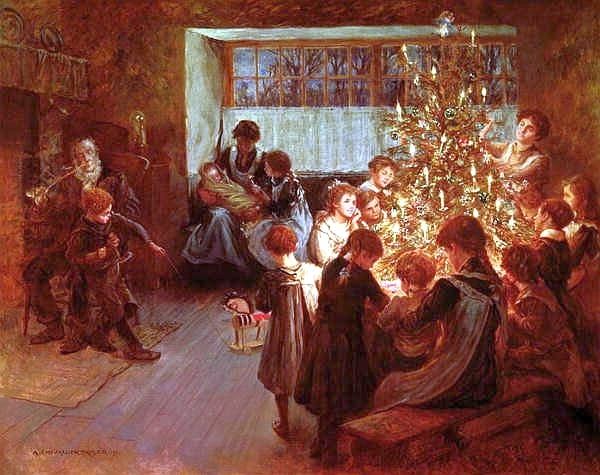
But there's something so beautiful to me about humans coming together during the darkest time of the year to eat, drink, and be merry together (even though sometimes we'd rather do anything else). And it's not exclusive to Christmas; nearly every culture in the world has a festival celebrating light during the winter. Yule, Chanukah, Diwali, Laylat al-Raghaib, Kwaanza, Bodhi Day. We deck our homes in string lights, light yule logs, sacrifice straw goats. In former Spanish territories like New Mexico, we fill paper bags with sand and tea lights and line our streets and driveways with them. When the sun disappears, we make our own light to guide our loved ones home.
And we eat! Oh, do we eat. From Thanksgiving to New Year's it feels like every other day is full of decadent meals and baked goods. Turkey, ham, mashed potatoes, green bean casserole, sweet potatoes (with marshmallows!), buttery rolls. So many cookies! For Italy and in Italian-American families they feast on seven fishes and in the former French colony of New Orleans we stay up all night restaurant hopping for réveillon. Keep your concerns about health and weight gain away from me, do you know how very human it is to eat and celebrate gluttony during a time of natural scarcity? During a time when nothing grows and we rely on our winter stores? And not only for ourselves, but we invite people into our homes and share whatever food and drink we have.
And the stories! I don't even care if we hear the same stories every year (there's only really one story humans tell anyway), they are stories we need to hear every year. Stories about overcoming impossible odds in darkness to once more be brought into the light, stories about being forgiven for past mistakes and given hope for a new future, stories about growing up but maintaining a sense of childlike wonder and magic, stories that remember the suns of summer and spring and promise those suns will come again.
I taught an Early British Literature survey course this semester (don't ask). We did the classics - Beowulf, Sir Gawain and the Green Knight, Faust, Gulliver's Travels - and on the last day of class I squeezed in "Auld Lang Syne" by Robert Burns. We watched one of my favorite Vlogbrothers videos, an essay from John Green's Anthropocene Reviewed in which he discusses the history of the song in the context of a friend's passing. We talked about why we choose the New Year, a time when ostensibly we are saying good bye to the old and hello to the new, to reflect on our past, and how so much of this time of year is steeped in old traditions.
And we sang together.
They hated every second of it. I knew they would. But we did it anyway.
I was invited to a local showing of National Lampoon's Christmas Vacation a couple nights ago. It was hosted by the local Civic Theater, and there was a costume contest and games and a raffle. And even though some in the audience had clearly seen the movie a million times before and even though all of us could've streamed this movie at home, instead we chose to be together and laugh and shout "I don't KNOW, Margo!" after Julia Louis-Dreyfus incredulously asks "And WHY is the CARPET all wet, TODD???"
I've been think about the "loneliness epidemic" a lot. I've been thinking of how the best times of my life were times when I was surrounded by people I loved and people I barely knew, united by a common cause or celebration. I've been thinking of how the morning after I passed my Dissertation Defense I gave a conference presentation to a room full of strangers and apologized if I seemed a little dazed and confused (hungover) and this room full of strangers all whooped and cheered and congratulated me. I've thinking about the annual holiday party I used to host in New Orleans where friends would bring people I'd never met to my home and I hugged them like they were family. I've been thinking about communal dinners in hostels with strangers when I was solo traveling through Europe and I've been thinking of the lady at the DMV who gave me detailed directions to the building across town rather than just telling me to look it up. I've been thinking of how my ex-husband left right before Christmas and my entire community came together to invite me to their family celebrations and traditions and I was so surrounded by unexpected love and kindness and generosity. And I've been thinking of how, even though I just moved here, I'm constantly being invited and included and introduced to new friends by people who may not know much about me but they know what it's like to be a stranger in a strange land.
Our increasingly tech-mediated lives combined with the changes brought on by COVID-19 means that these experiences are becoming more and more rare. There's a great anecdote by Kurt Vonnegut, recounted in an interview with PBS's David Brancaccio during a promo for his latest book, A Man Without a Country:
DAVID BRANCACCIO: There's a little sweet moment, I've got to say, in a very intense book — your latest — in which you're heading out the door and your wife says what are you doing? I think you say — I'm getting — I'm going to buy an envelope.
KURT VONNEGUT: Yeah.
DAVID BRANCACCIO: What happens then?
KURT VONNEGUT: Oh, she says well, you're not a poor man. You know, why don't you go online and buy a hundred envelopes and put them in the closet? And so I pretend not to hear her. And go out to get an envelope because I'm going to have a hell of a good time in the process of buying one envelope.
I meet a lot of people. And, see some great looking babes. And a fire engine goes by. And I give them the thumbs up. And, and ask a woman what kind of dog that is. And, and I don't know…
And, of course, the computers will do us out of that. And, what the computer people don't realize, or they don't care, is we're dancing animals. You know, we love to move around. And, we're not supposed to dance at all anymore.
So I asked my students to sing with me and despite their cringe for a few beautiful moments we were able to create that magic in the classroom. That sense of truly being with someone and acknowledging that "we're here because we're here because we're here because we're here."
Maybe it's because I suffer from seasonal depression or maybe I'm just hopelessly optimistic about the human condition, but that's why I love this time of year. We have every reason to sulk in darkness, to not venture out, to bundle up at home and doomscroll. Family can be arduous, friends may be overwhelming, but we damn near force ourselves to show up for our community because that's what we owe to each other. We're here because we're here, and we'll light up our homes and we'll sing carols and we'll break bread and toast together. Even though the days keep getting shorter and darker and colder, the Winter Solstice comes and we survive the longest night of the year together by gathering around a hearth together and sharing food and wine together and singing songs together. The sun returns, the days stretch minute by minute, and the icy ground begins to thaw.
Happy solstice, friends. The sun is returning and will keep returning no matter how long and dark the night seems. Until then, we'll make our own light together.